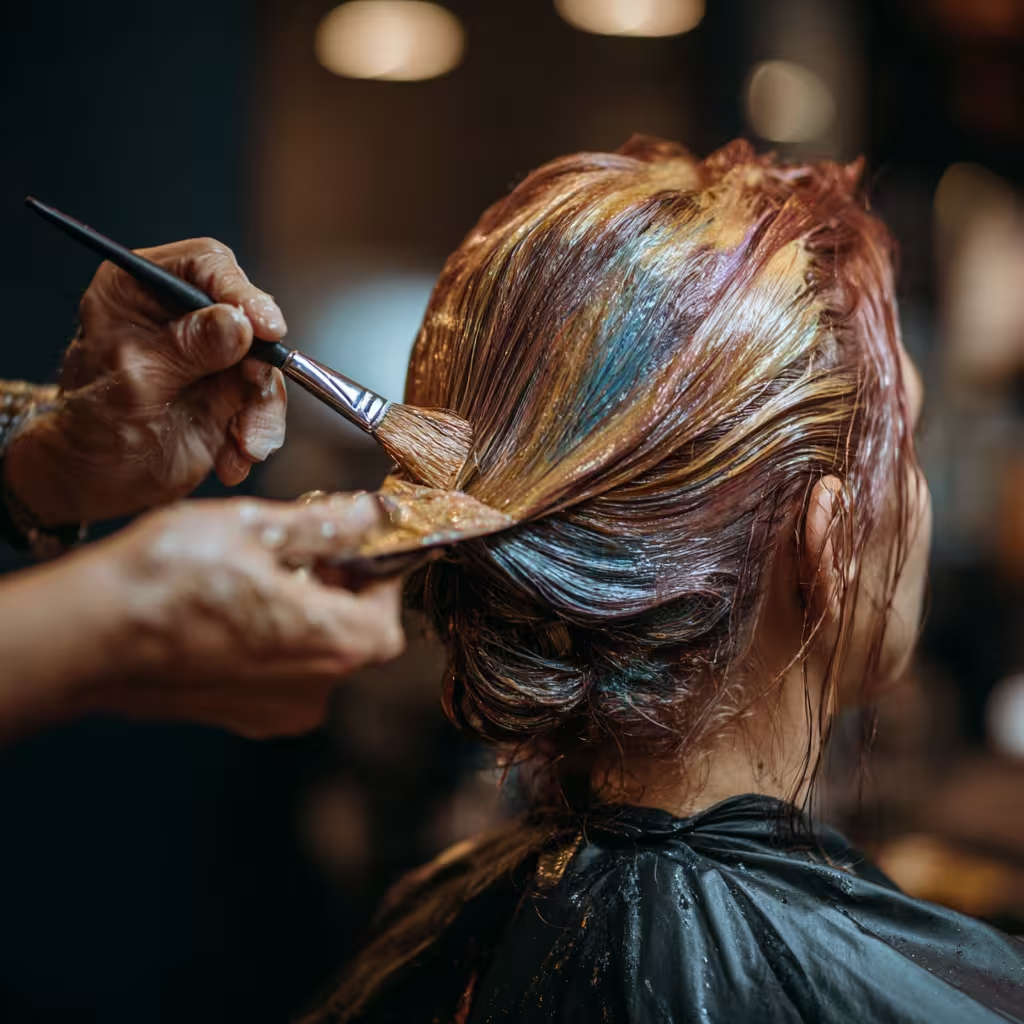
For years, I dyed my hair. Almost every time I went to the hairdresser, the same thing happened. My face would go red, my cheeks would flush and my skin would feel warm. Sometimes the redness faded quickly; other times it lingered.
Six weeks later, I’d be back in the hairdresser’s chair. As soon as my roots started to show, I booked another appointment. It was part of my routine, and I barely gave it a second thought.
Usually, I put my skin reactions down to my rosacea. That seemed a logical explanation, although I had never looked into whether hair dye might play a part.
As I began looking more closely at the ingredients in everyday products for Leef in Regie, I also started questioning what was in my hair dye. What actually happens when you dye your hair? Which substances are used? And what do we know about the possible risks?
What actually happens during dyeing?
Permanent hair dye does more than simply coat your hair with colour. Its ingredients react with one another to create a colour that lasts.
Most permanent dyes use hydrogen peroxide, along with substances that help the colour develop in the hair. Some products also contain ammonia or an alternative to it.
The exact ingredients vary between hair dyes. One ingredient found in some products is PPD (p-phenylenediamine), which is used in certain darker hair colours.
PPD stood out to me, because it is a known cause of allergic reactions to hair dye.
Why might your skin react to hair dye?
A red face, itching or a burning sensation during hair colouring can have several causes.
Sometimes an ingredient irritates the skin on direct contact. This kind of reaction often occurs during or shortly after dyeing.
An allergy works differently. Your immune system reacts to a substance you have become sensitised to. Symptoms may also appear hours or even days later, including itching, eczema or swelling.
PPD is a well-known trigger of this type of allergic reaction, but other ingredients can cause skin complaints too.
However, a recurring skin reaction does not automatically mean you have an allergy. A dermatologist can use a patch test to investigate whether you have a contact allergy.
Hair dye also gets on your scalp
When touching up your roots, hair dye usually comes into direct contact with your scalp.
Our skin protects us from the outside world, but it is not a complete barrier. Small amounts of some ingredients can be absorbed through the skin. How much depends on factors such as the product and how it is used.
Within the European Union, cosmetics are subject to safety regulations. There are, for example, maximum permitted concentrations for certain substances used in hair dyes. Even so, products that comply with these rules can still cause skin reactions in some people.
Hair dye and cancer: what do researchers know?
While researching, I also came across studies on possible links between hair dye and cancer.
For decades, scientists have been investigating whether using hair dye is associated with an increased risk of certain types of cancer.
Here, there is an important distinction between people who dye their own hair and hairdressers who work with hair dye and other hair products professionally on a regular basis.
The International Agency for Research on Cancer (IARC), part of the World Health Organization, classifies occupational exposure among hairdressers as probably carcinogenic. This assessment concerns the work as a whole and does not mean that every individual hair dye is carcinogenic.
For people who dye their own hair, the scientific picture is less clear.
Some studies have found an association with certain types of cancer, while others have found no convincing evidence of a link. Hair dye ingredients have also changed over the years.
There is therefore not enough evidence to classify personal hair dye use as carcinogenic. At the same time, that does not prove there is no risk at all.
For me, this was mainly interesting background information. What weighed more heavily in my decision were my own skin reactions and the questions I had about the ingredients.
Stopping dyeing was harder than I thought
Coloured hair had become so normal to me that I could barely imagine what it would be like to stop.
Visible roots bothered me, and after every visit to the hairdresser my hair felt freshly done and well cared for.
Once I’d decided to stop, I had to get used to seeing my natural hair colour again. To be honest, that wasn’t easy.
Is natural hair dye a better alternative?
Anyone looking for other types of hair dye will soon come across terms such as natural, plant-based, mild and ammonia-free.
These terms may sound reassuring, but they don’t necessarily tell you anything about how likely a skin reaction is.
Even ammonia-free hair dye can contain ingredients that cause irritation or allergic reactions.
Henna is a well-known plant-based dye. Products sold as black henna, however, may contain added PPD. Black henna, particularly when used for temporary skin tattoos, is known for its risk of severe allergic reactions.
So even with products marketed as natural, it remains important to look at the ingredients.
If you regularly experience redness, itching or swelling during or after dyeing, discuss this with a doctor before using hair dye again.
How I see it now
I no longer dye my hair.
The appointments every six weeks are a thing of the past, and I don’t miss them. Touching up my roots is no longer something I have to think about, and by now I’ve grown used to my natural hair colour.
Whether my skin reactions back then were actually caused by the hair dye, I don’t know. That was never investigated.
What began with curiosity about an ingredient list led me to let go of a habit I’d taken for granted for years. And I’m actually quite happy with that.
Sources
- American Cancer Society – Hair Dyes and Cancer Risk. Research on possible links between hair dye and cancer, distinguishing between personal and occupational use.
https://www.cancer.org/cancer/risk-prevention/chemicals/hair-dyes.html - NHS – Hair dye reactions. Explanation of skin irritation, allergic reactions, and PPD.
https://www.nhs.uk/conditions/hair-dye-reactions/ - FDA – Hair Dyes. Information on hair dye ingredients, safety, and allergic reactions.
https://www.fda.gov/cosmetics/cosmetic-products/hair-dyes - European Commission / SCCS – Resorcinol. European safety assessment of resorcinol, an ingredient found in certain hair dye products.
https://health.ec.europa.eu/publications/resorcinol_en