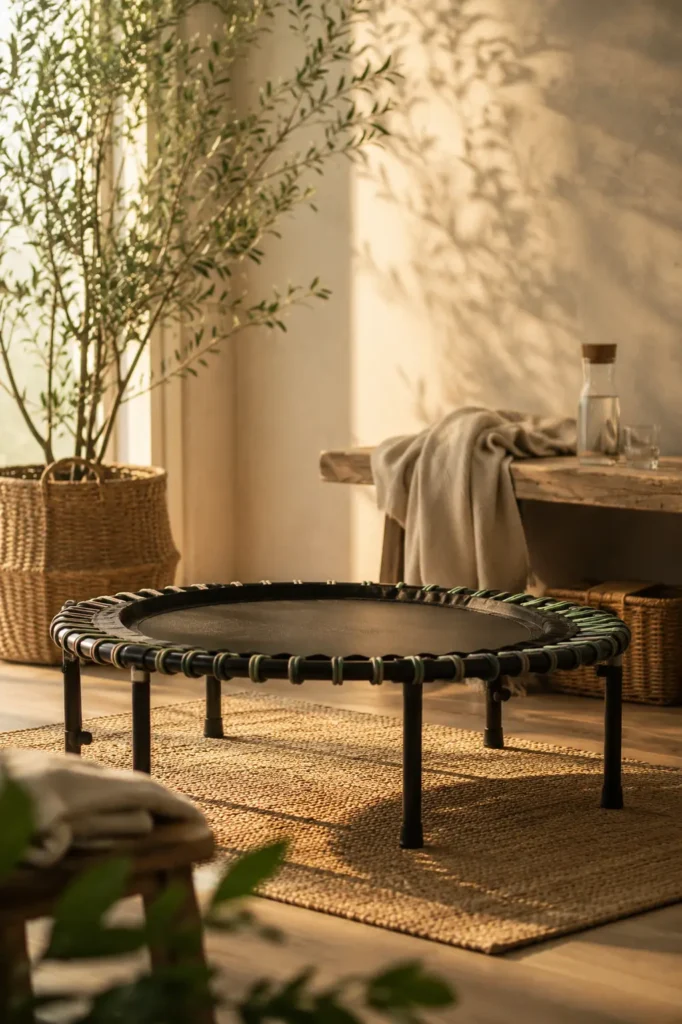
A few minutes on a mini-trampoline might not seem like much. You stand on a springy mat, move gently up and down, and before you know it, you’re finished. Meanwhile, your body is constantly at work. Your muscles respond to the movement, your balance is challenged, and depending on the pace, your heart rate and breathing can increase significantly.
I was first introduced to the mini-trampoline by my sister-in-law, who has a naturopathic practice. That made me curious. What actually happens during the bouncing motion? And what do we know from research about this form of exercise?
We now have a bellicon mini-trampoline (affiliate link) at home. We mainly use it to get moving during breaks.
Your body is constantly adjusting to maintain balance
When you stand on a regular floor, you have a solid surface under your feet. On a mini-trampoline, that surface moves with you. Every time the mat sinks and bounces back, your body must adjust.
Various muscle groups work together during this process. Your ankles and legs help you stay stable, while muscles around your hips and core contribute to your posture. Your sense of balance and coordination also play a role. The remarkable thing is that you don’t have to jump high at all. Even when your feet stay on the mat and you only bounce gently up and down, the surface is constantly changing.
Your body continuously makes small corrections to maintain your posture. This makes the movement different from standing or moving on a fixed floor. Whether such exercises actually improve your balance depends, among other things, on the specific exercises, the duration of training, and your starting point. Research into the effects of mini-trampoline exercises on balance is still limited.
From gentle bouncing to a full cardio workout
A mini-trampoline can be used in various ways. You can bounce gently with both feet on the mat, lift your feet alternately, or do exercises where you actually jump. How intense the movement is depends on the tempo, the range of your movements, and the exercises you perform.
With gentle bouncing, the emphasis is primarily on movement, posture, and maintaining your balance. When you increase the tempo or make larger movements, your muscles have to work harder, and your heart rate and breathing may increase. This allows you to use the mini-trampoline for a short, gentle movement break, but also for a more intensive cardio workout.
Interestingly, this exertion does not always have to feel as heavy as you might expect based on your heart rate. This was also highlighted in a study on mini-trampoline training.
What does research say about training on a mini-trampoline?
In 2016, the American Council on Exercise (ACE) commissioned a study to see how intensive training on a mini-trampoline can be. Twenty-four healthy, physically active students participated in the study. They performed a 19-minute trampoline workout, during which researchers measured their heart rate and oxygen consumption, among other things. Participants were also asked how strenuous they found the exertion themselves.
During the active part of the training, the average heart rate was at 79% of the maximum heart rate and oxygen consumption was at 59% of the maximum oxygen consumption. These values correspond to moderate to vigorous physical exertion. Notably, participants perceived the workout as relatively light to moderate, even though the measurements indicated a higher level of physical exertion.
A possible explanation is that the bouncing motion feels different from moving on a hard surface. Enjoyment of the exercises may also play a role. These were the researchers’ own suggestions; the study did not test them.
The research shows that a mini-trampoline can be used for moderate-to-vigorous aerobic exercise. However, an important distinction is necessary: the participants followed a specific workout with various exercises. Therefore, the results do not automatically apply to a few minutes of gentle bouncing. The study was also relatively small and focused on physical exertion during a single workout rather than the long-term effects of regular training. It is also worth knowing that the workout was designed by trampoline manufacturer JumpSport, and that the study was commissioned by ACE rather than published in a peer-reviewed scientific journal.
What makes the bouncing surface different?
When walking, running, or jumping on a solid surface, the ground hardly moves. This is different on a mini-trampoline. The mat and the suspension respond to your body weight and the force you exert. During bouncing, pushing off, decelerating, and accelerating again constantly alternate, with different muscle groups working together to keep the movement controlled.
How that feels differs per trampoline and per person. The type of suspension, the tension of the mat, your body weight, and your posture all play a role. A springy surface may feel more comfortable than a hard floor, but that doesn’t necessarily mean every exercise puts less strain on your joints.
This difference is important because mini-trampolines are frequently promoted as a particularly gentle way to move. The suspension changes how forces are absorbed, but the actual strain on your muscles and joints also depends on how you move and how intensely you exercise. Especially with vigorous jumping, good control and a gradual build-up remain important.
How do you start safely?
Anyone standing on a mini-trampoline for the first time should start slowly. Your body needs to get used to a surface that is constantly moving. For example, start with both feet on the mat and make small, controlled bouncing movements while keeping your knees slightly bent. You don’t have to let your feet leave the mat. Once you feel stable and the movement feels comfortable, you can gradually increase the duration or intensity.
Ensure the trampoline is stable and level, and that there is sufficient space around it. A support bar can provide extra stability if you feel uncertain about your balance. If you have balance difficulties, experience dizziness, have a recent injury or have a condition that could be aggravated by jumping, it’s advisable to consult a healthcare professional before starting.
The mini-trampoline also doesn’t have to be an intensive training tool. Those who primarily want to move more often during the day can stick to gentle bouncing. You can adapt how you use it to your own abilities and what feels comfortable.
A simple way to move more
What we particularly like about the mini-trampoline at home is how easily you can use it in between tasks. After a long period behind a screen, you can just stand on it and move for a bit without having to change clothes or follow a training programme. Sometimes we bounce gently for a few minutes, and sometimes we move more intensively. For us, it’s an easy and accessible way to break up long periods of sitting and get moving again.
Moving regularly and limiting prolonged sitting are both important for a healthy lifestyle. A mini-trampoline can be a practical addition to walking, cycling, strength training, and other forms of exercise. How much it contributes to your fitness or muscle strength depends on how often, how long, and how intensively you move.
For us, the added value lies mainly in the convenience. The mini-trampoline is within reach, making it easy to get a few extra minutes of movement even on busy days. The study shows that you can train seriously with it, but that doesn’t have to be the goal. Even if you mainly use it to take more frequent breaks from sitting, it can easily become part of your daily routine.
This blog post contains an affiliate link to bellicon, a brand Leef in Regie works with. We were already using our bellicon before this collaboration began. When you buy something through our link, we receive a commission. You pay nothing extra for this.
Sources
- American Council on Exercise (ACE) – Putting Mini-trampolines to the Test (2016)
- Cleveland Clinic – The Many Health Benefits of Exercising on a Trampoline
- Praktijk Hof van Eden – personal source of inspiration